Carbon removal.
Built to multiply.
AIR-ROCK is engineering a radically simple mineral carbon-removal platform: move ordinary air across reactive alkaline material, lock CO₂ into stable carbonate, then replicate the hardware at industrial scale.
AIR-ROCK is an early-stage technology under development. Performance figures on this site that are labelled targets or projections are forward-looking engineering goals, not measured AIR-ROCK production.
Make the machine cheap enough that scale becomes repetition.
Most carbon-removal systems chase a bigger plant. AIR-ROCK is taking the opposite route: simple modules, inexpensive mineral feedstocks, ultra-low-pressure airflow and continuous chemistry optimisation.
Capture from ordinary air
Outdoor air is pulled through a low-pressure contactor containing reactive alkaline mineral media.
Lock it into rock
CO₂ reacts with calcium- and magnesium-bearing material to form stable solid carbonates.
Replicate, don’t overbuild
Standardised AIR-BRICK modules are intended to be copied by the hundred or thousand rather than replaced by one complex plant.
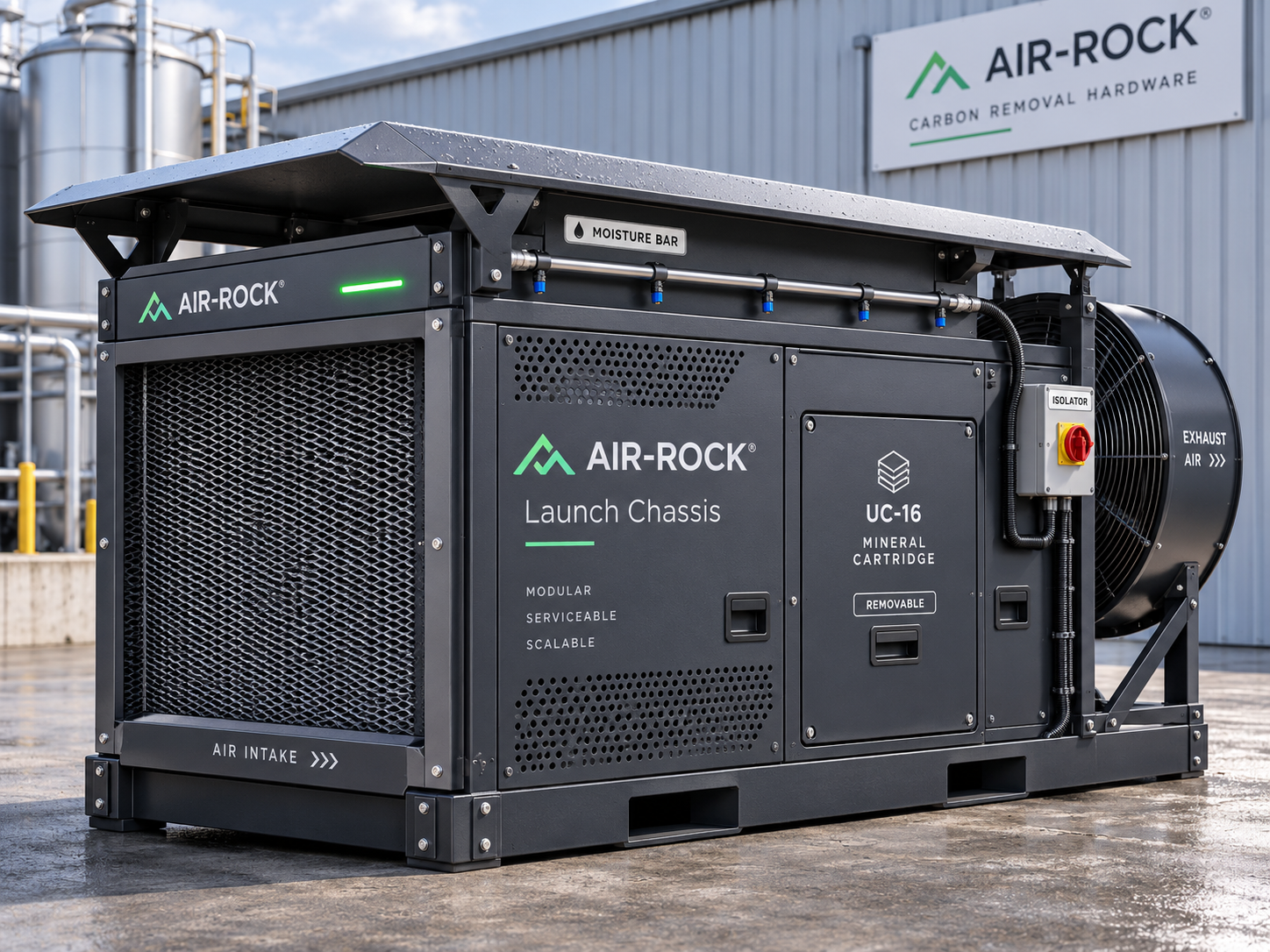
The hardware is intentionally boring.
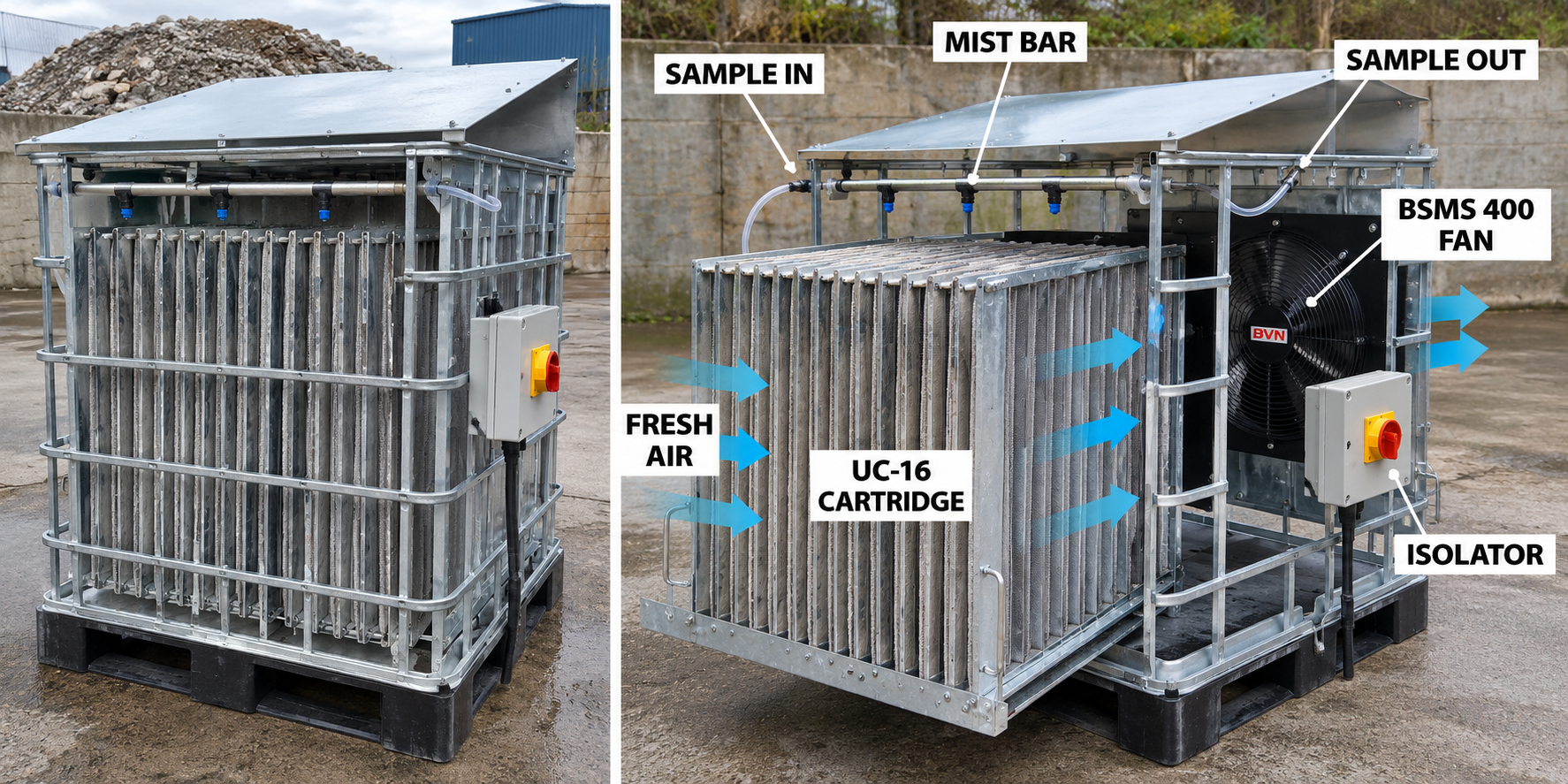
The value is in what passes through the cartridge, not in an expensive steel box. The launch chassis is designed around a cheap frame, removable mineral cartridge, simple moisture control and a fan.
per AIR-BRICK, after the R&D programme optimises feedstock, moisture, particle size, geometry and operating strategy.
This is a design target based on first-principles airflow modelling and published mineralisation science. AIR-ROCK has not yet measured this output in its own hardware.Low-energy hardware designed to pair with renewables.
AIR-ROCK's scale-up architecture is designed around very low electrical demand, with production sites planned to combine rooftop solar, wind where appropriate, and grid electricity during build-out and balancing.
Every watt avoided improves both carbon-removal economics and net-removal accounting.
This describes AIR-ROCK's planned deployment architecture. It is not a claim that current development hardware is already powered by renewable electricity.Help launch the first 1,000 tonnes.
A limited forward-purchase programme for organisations willing to back an early permanent carbon-removal technology before commercial deployment.
Founding allocation
- €1,000/t
- First-production priority
- Quarterly development updates
- Founding Buyer recognition
Founding allocation
- €1,000/t
- First-production priority
- Quarterly development updates
- 15% future-price preference*
Volume Partner
- €950/t
- Volume Partner status
- First-production priority
- 15% future-price preference*
Founding Anchor
- €900/t
- Founding Anchor Partner status
- Priority allocation
- Senior technical access
The pathway already exists. The engineering is the opportunity.
Published work has demonstrated atmospheric carbonation of cementitious material. Frontier is actively funding surficial mineralisation R&D, and Isometric maintains an open-system mineralisation protocol that includes waste cement and demolition waste as potentially applicable feedstocks.
A 2023 Journal of Advanced Concrete Technology study reported 11.75 g CO₂ per 100 g of hydrated cement paste after 120 hours in a wet natural-air carbonation setup.
Read the paper →Frontier identifies surficial mineralisation as a high-potential pathway and is seeking better contact architectures, mineral pretreatment and scalable low-cost MRV.
Frontier Innovation →Open-system ex-situ mineralisation via Enhanced Air Capture already has a protocol framework, including waste cement and demolition waste among applicable feedstock categories.
View protocol →Back the first machines.
Founders 1,000 is designed to fund the proof programme, first AIR-BRICK fleet and the path to independently verified delivery.